Case Studies·02·Primary research·Defense·ARES

Research is the foundation.

As a product designer at Odyssey Systems Consult, I support Kessel Run's software modernization efforts: replacing six fragmented legacy aircrew scheduling and training systems with the Aerospace Readiness Enterprise System (ARES) for more than 149,000 Airmen across the Department of the Air Force (DAF). I've led all of the program's user research to date.

Before a single wireframe was drawn, I did the work that makes real design possible. Eight research trips across CONUS and OCONUS, including one overseas simulation exercise, embedded with the operational stakeholders who will actually use what we're building. This case study isn't about the software. It's about the research that earns the right to design it.
ARES, Aerospace Readiness Enterprise System, badge
Research trips
8
CONUS + OCONUS
Warfighters
100+
interviewed
Personas
6
defined
Journey maps
12
current + future
Empathy maps
Dozens
and syntheses
$100M In the news · DefenseScoop · Aug 25, 2026 Air Force awards $100M production deal for AI-enabled readiness platform ARES moves into production, with major commands receiving it starting in 2027.

01 · Why research

Grounded in data, not opinions.

Research isn't a checkbox. It's continuous discovery inside every iteration sprint: identifying and framing the real problem, validating and refining ideas, and gathering the insights that reveal what we'd otherwise overlook.

It's not always about which features to prioritize. Sometimes it's about the outcome, the future state. That's a different question than "what should we build," and it's the one that matters most for a program of this scale.

How do we change the way it's done today for a better solution tomorrow?

Every research effort starts with fundamental questions

  1. Who are the warfighters using this?
  2. What are their needs, goals, and pain points?
  3. What jobs and tasks do they need to do?
  4. What decisions do they need to make?
  5. What does a better future state actually look like?
  6. Where are the gaps between what exists and what's possible?
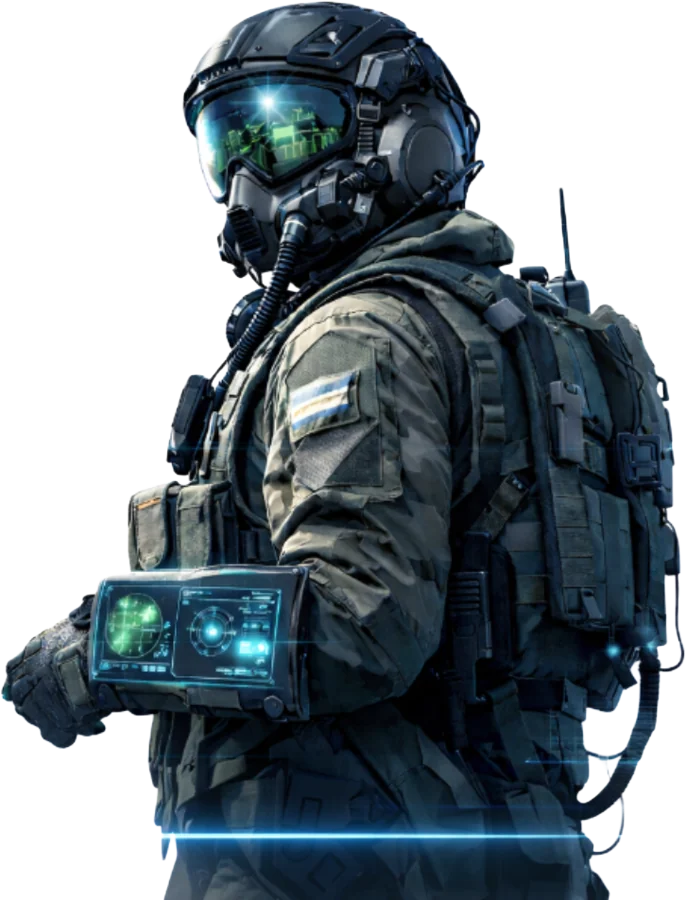
Illustration of a warfighter in flight gear with a wrist-mounted display

You cannot answer these from a conference room in Boston.

02 · Before the trip

A research trip doesn't start on the plane. It starts weeks earlier.

Every trip is planned with the same rigor as the design work itself.

01

Research plan

Goals, objectives, and success criteria defined upfront.

02

Methodology selection

Qualitative, quantitative, or mixed. Moderated or unmoderated. Generative or evaluative.

03

Interview scripts

Written before we leave, so questions are consistent across participants and comparable in synthesis.

04

Participants confirmed

Scheduled and briefed before arrival, so we're not burning operational time chasing meetings.

05

Prototypes and wireframes prepared

Ready for A/B testing when the conversation calls for it.

06

Participant trackers built

So follow-on designers know exactly who's been spoken to, when, and about what.

The last one matters more than people realize. On a program of this scale, with a team that will keep growing, the tracker is what prevents institutional knowledge from evaporating between rotations.

03 · On the ground

Immersion until it's second nature.

Once we're on site, the work shifts. A researcher's job is to immerse themselves in the product domain and the user's world until we understand not just the workflows, but the culture, the pressure, and the trade-offs users make daily.

01

Contextual inquiry

Watching users do their actual work in their actual environment.

02

Observational research

Noting what happens between the tasks, which is often where the real friction lives.

03

One-on-one interviews

For depth, from 20-minute sessions to days long when needed, to build the trust that surfaces the honest answers.

04

A/B testing wireframes and prototypes

When we have concepts ready to validate.

05

Field metrics

Time on task, time to complete a build, which pages users linger on, which they abandon.

I don't rush interviews. The second interview is always more honest than the first.

04 · After the trip

Synthesis is where research becomes design.

Field notes and interview transcripts on their own are just raw material. Synthesis is the discipline that turns them into decisions. Using Lucid, Miro, and Figma, I generate:

01

Affinity maps

Clustering hundreds of individual observations into thematic patterns.

02

Personas

Grounded in real warfighters, not marketing archetypes.

03

User journey maps

The full arc of what an operator actually does, moment by moment.

04

Future state journey maps

Showing where we're headed, not just where we are.

05

Empathy maps

What users say, do, and think often diverge. Empathy maps make that divergence visible.

06

UX research briefs

Synthesized findings written for executive stakeholders, product owners, and engineering.

07

Pain point metrics

Quantified, prioritized, and traceable back to the warfighters who raised them.

08

UXR playback briefs

Iterative reports that keep the program aligned on what we're learning as we learn it.

05 · A repeatable practice

The real work is the research. Making it repeatable is what makes it scale.

Every site visit had a research plan. Every interview had a script. What was standard was the practice: same format, same file structure, same synthesis methodology, same brief template. Everything documented, organized, and discoverable.

If I knew I was about to interview the same persona a coworker had already spoken to, I could find their script, copy it, and adapt it to what my team needed to learn next. No starting from zero. No re-litigating decisions. No lost context.

On a program with turnover, rotations, and a growing team, that's what keeps the research compounding instead of resetting.

06 · What this changes

Actionable recommendations, not observations.

The end of research isn't a report. It's a set of decisions the team can act on: patterns to redesign, workflows to eliminate entirely, futures to design toward.

And then the loop closes. We implement, we evaluate impact, and we go back into the field.

That research is now heading into production. In August 2026 the Air Force awarded a $100 million production agreement for ARES after a 90-day competitive prototype evaluation, where operators tested competing prototypes and their feedback informed the final selection. Kessel Run will keep traveling to bases to gather operator feedback that drives continuous updates. Read the coverage ↗

Every minute we design out of a workflow is a minute the warfighter gets back for the mission itself.

← All workCase studies Case study 03 →Brand that earns trust